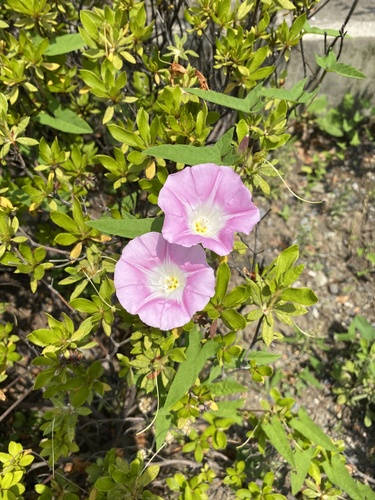
Japanese false bindweed (Calystegia hederacea)
Other names ivy-leaved false bindweed
At a glance
- Lifecycle
- Perennial (hardy)
- Exposure
- Full sun
- Frost limit
- −28.9 °C
Cultivation
Easily grown in ordinary garden soil in a sunny position, but plants are apt to become invasive. Nearly all taxa in Calystegia intergrade geographically into neighboring taxa with the exception of the widespread coastal species, C. soldanella (Linnaeus) R. Brown. It is impossible to draw clearly defined specific limits, and intermediate forms are always found where two taxa approximate geographically.
Propagation
Seed - sow spring in a cold frame in a free draining compost and only just cover. The seed usually germinates in 1 - 3 months at 15°c. When they are large enough to handle, prick the seedlings out into individual pots and grow them on in a cold frame for at least their first winter. Plant them out into their permanent positions in late spring or early summer, after the last expected frosts. Division in early spring whilst dormant.
Edible uses
Root - cooked. Young shoots - cooked.
Medicinal uses
The seed is simmered in water as a diuretic to stimulate kidney secretions.
Habitat
Sunny grassy places and thickets in lowland and hills of C. and S. Japan.
Native range
E. Asia - Japan, Korea, Manchuria.
Same genus
- Catesby's false bindweed (Calystegia catesbeiana)
- Coast range false bindweed (Calystegia collina)
- Lucky false bindweed (Calystegia felix)
- Paiute false bindweed (Calystegia longipes)
- Macoun's false bindweed (Calystegia macounii)
- Island false bindweed (Calystegia macrostegia)
- Chaparral false bindweed (Calystegia occidentalis)
- Peirson's false bindweed (Calystegia peirsonii)