Scottish licorice-root (Ligusticum scoticum)
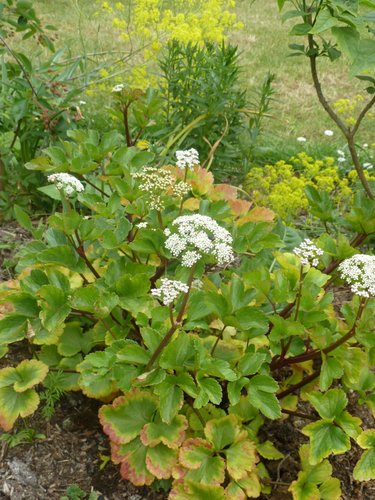
At a glance
- Lifecycle
- Perennial (hardy)
- Exposure
- Full sun
- Frost limit
- −34.4 °C
Cultivation
Succeeds in any well-drained soil in a sunny position. Plants are hardy to at least -15°c. Scottish lovage has occasionally been cultivated as a pot herb, though it has been largely supplanted by celery. All parts of the plant are aromatic when bruised, the aroma being likened to a mixture of parsley, angelica and pear skin.
Propagation
Seed - the seed only has a short period of viability and so is best sown as soon as it is ripe in a cold frame in the autumn. Stored seed should be sown as early in the year as possible in a greenhouse or cold frame. Prick out the seedlings into individual pots when they are large enough to handle and plant them out into their permanent positions in the summer if they have grown large enough. Otherwise, keep them in a cold frame for the first winter and plant them out in early summer. Division of the rootstock in early spring. Make sure that each section of root has at least one growth bud. Very easy, larger clumps can be replanted direct into their permanent positions, though it is best to pot up smaller clumps and grow them on in a cold frame until they are rooting well. Plant them out in the spring.
Edible uses
Leaves, flowers and young shoots - raw or cooked. Stem - used as a flavouring in soups, stews etc. Root - raw or cooked. Seed - ground into a powder and used as a flavouring in soups and stews. The young shoots and roots are occasionally candied like angelica.
Medicinal uses
The root is aromatic and carminative. The seeds are sweetly aromatic and have been used as a carminative, deodorant and stimulant.
Habitat
Rocky coasts in northern Britain.
Native range
Northwestern Europe, including Britain, from Denmark to Norway.
Same genus
- Calder's licorice-root (Ligusticum calderi)
- California licorice-root (Ligusticum californicum)
- Canadian licorice-root (Ligusticum canadense)
- Canby's licorice-root (Ligusticum canbyi)
- Fernleaf licorice-root (Ligusticum filicinum)
- Gray's licorice-root (Ligusticum grayi)
- Porter's licorice-root (Ligusticum porteri)
- Northern licorice-root (Ligusticum verticillatum)