Abutilon vitifolium
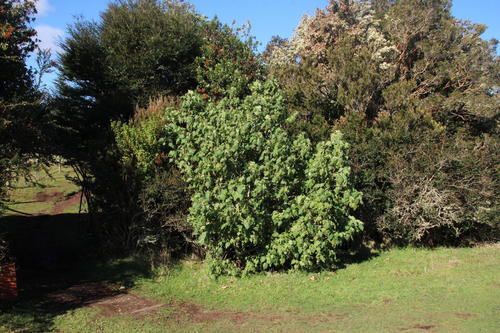
At a glance
- Lifecycle
- Perennial (hardy)
- Exposure
- Full sun
- Frost limit
- −12.2 °C
Cultivation
An easily grown plant, fast to establish and flower from seed and growing best in coastal areas. This species is only hardy in the mildest areas of Britain, tolerating temperatures down to between -5 to -10°c when given the protection of a south or south-west facing wall. A plant of the cultivar 'Album', growing in an open position at Westonbirt Arboretum, was 2 metres tall and flowering prolifically in June 1994[K]. Plants tend to be short-lived in Britain, dying suddenly without any apparent cause. This is probably because they flower so profusely that they die of exhaustion. Tip-prune young plants to promote a bushy habit, older plants can be cut back hard annually in spring if required. There are some named forms, selected for their ornamental value. 'Album' has very nice tasting flowers[K]. Plants in this genus are notably resistant to honey fungus.
Propagation
Seed - sow spring in a greenhouse. Germination should take place within a few weeks. Once the seedlings are large enough to handle, prick them out into individual pots. Grow them on for at least the first winter in a greenhouse and plant out in late spring or early summer, after the last expected frosts. Cuttings of young shoots, June in a frame. Grow on in the greenhouse for their first winter and plant out in spring after the last expected frosts. Cuttings of half-ripe wood, July/August in a frame. Grow on in the greenhouse for their first winter and plant out in spring after the last expected frosts.
Edible uses
Flowers - raw. The flowers are up to 8cm in diameter. A delicious mild flavour with a slight sweetness, they have a pleasant mucilaginous texture and can be eaten in quantity as part of a salad[K].
Habitat
Open places in warm temperate forests.
Native range
S. America - Chile.
Same genus
- Florida Keys Indian mallow (Abutilon hirtum)
- Mauve (Abutilon hulseanum)
- Parish's Indian mallow (Abutilon parishii)
- Coastal Indian mallow (Abutilon permolle)
- Yellowflower Indian mallow (Abutilon reventum)
- Velvetleaf (Abutilon theophrasti)
- Wright's Indian mallow (Abutilon wrightii)
- Viscid mallow (Abutilon viscosum)