Tung Tree (Aleurites fordii)
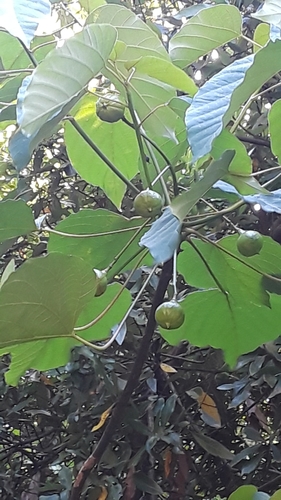
At a glance
- Lifecycle
- Perennial (hardy)
- Exposure
- Full sun
- Frost limit
- −1.1 °C
Cultivation
One report says that the plant is very tolerant of soil conditions. Tung trees are very exacting in climatic and soil requirements. Production of tung is best where day and night temperatures are uniformly warm. Much variation reduces tree growth and fruit size. Trees grow best if planted on hilltops or slopes, as good air-drainage reduces losses from spring frosts. Contour-planting on high rolling land escapes frost damage. Tung makes its best growth on virgin land. Soils must be well-drained, deep aerated, and have a high moisture-holding capacity to be easily penetrated by the roots. Green manure crops and fertilizers may be needed. Dolomitic lime may be used to correct excessive acidity; pH 6.0 - 6.5 is best; liming is beneficial to most soils in the Tung Belt, the more acid soils requiring greater amounts of lime. Trees are not very cold hardy outdoors in Britain. A very ornamental tree. Seedlings generally vary considerably from parent plants in growth and fruiting characters. Seedlings which have been self-pollinated for several generations give rather uniform plants.
Propagation
Seed - sow March/April in a warm greenhouse. When large enough to handle, prick the seedlings out into individual pots and grow them on for at least the first winter in a greenhouse. Plant out in early summer and give the plants some protection from the cold for their first winter outdoors. Tung seed are normally short-lived and must be planted during the season following harvest. Seeds are best hulled before planting, as hulls retard germination. Hulled seed may be planted dry, but soaking in water for 5 - 7 days hastens germination. Stratification, cold treatment or chemical treatment of seeds brings about more rapid and uniform germination. Dry-stored seed should be planted no later than February; stratified seed by mid-March; cold-treated and chemical treated seed by early April. Cuttings of mature wood in a frame. Most successful budding is done in late August, by the simple shield method, requiring piece of budstock bark, including a bud, that will fit into a cut in the rootstock bar.
Edible uses
Seed.
Medicinal uses
The oil from the seed is used externally to treat parasitic skin diseases, burns, scalds and wounds. The plant is emetic, antiphlogistic and vermifuge. Extracts from the fruit are antibacterial.
Material uses
The seed contains up to 58% of a superior quick-drying oil that is used in the manufacture of lacquers, varnishes, paints, linoleum, oilcloth, resins, artificial leather, felt-base floor coverings, greases, brake-linings and in clearing and polishing compounds. Tung oil products are used to coat containers for food, beverages, and medicines; for insulating wires and other metallic surfaces, as in radios, radar, telephone and telegraph instruments. Tung trees usually begin bearing fruit the third year after planting, and are usually in commercial production by the fourth or fifth year, attaining maximum production in 10 - 12 years. Average life of trees in United States is 30 years. Fruits mature and drop to ground in late September to early November. At this time they contain about 60% moisture. Fruits must be dried to 15% moisture before processing. Fruits should be left on ground 3 - 4 weeks until hulls are dead and dry, and the moisture content has dropped below 30%. Fruits are gathered by hand into baskets or sacks. Fruits do not deteriorate on ground until they germinate in spring.
Habitat
Base of foothills esp. in rocky places, to 1000 metres in W. China.
Native range
E. Asia - Central and Western China.