Quebec Berry (Amelanchier stolonifera)
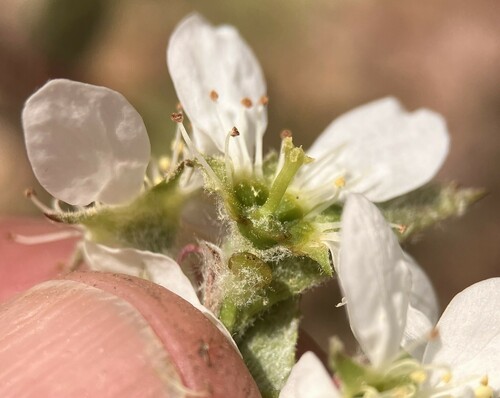
At a glance
- Lifecycle
- Perennial (hardy)
- Exposure
- Full sun
- Frost limit
- −34.4 °C
Cultivation
Dislikes calcareous soils. All members of this genus have edible fruits and, whilst this is dry and uninteresting in some species, in many others it is sweet and juicy. Many of the species have potential for use in the garden as edible ornamentals. The main draw-back to this genus is that birds adore the fruit and will often completely strip a tree before it is fully ripe[K]. Produces suckers quite freely, the plant forms thickets. When propagated by these suckers, the new plants can begin producing a crop of fruit in their second year[K]. The sub-species A. stolonifera micropetala was seen growing in dappled shade at Hilliers Arboretum in early April 1999. It was about 2 metres tall, suckering freely with some suckers more than 50cm from the parent plant, and flowering freely[K]. Hybridizes with A. arborea, A. bartramiana, A. laevis and A. sanguinea. Grafting onto seedlings of A. lamarckii or Sorbus aucuparia is sometimes practised in order to avoid the potential problem of hybridizing.
Propagation
Seed - it is best harvested 'green', when the seed is fully formed but before the seed coat has hardened, and then sown immediately in pots outdoors or in a cold frame. If stored seed is obtained early enough in the autumn, it can be given 4 weeks warm stratification before being left out in the winter and it should then germinate in the spring. Otherwise seed can be very slow to germinate, perhaps taking 18 months or more. When large enough to handle, prick the seedlings out into individual pots and grow them on in a sheltered outdoor position, planting them out once they are 20cm or more tall. If there is sufficient seed it is best to sow it thinly in an outdoor seedbed. Grow the seedlings on for two years in the seedbed before planting them out into their permanent positions during the winter. Layering in spring - takes 18 months. Division of suckers in late winter. The suckers need to have been growing for 2 years before you dig them up, otherwise they will not have formed roots. They can be planted out straight into their permanent positions if required.
Edible uses
Edible fruit - raw or cooked.
Medicinal uses
The root bark has been used as a tonic.
Habitat
Dry acid rocky or sandy open habitats.
Native range
Eastern N. America