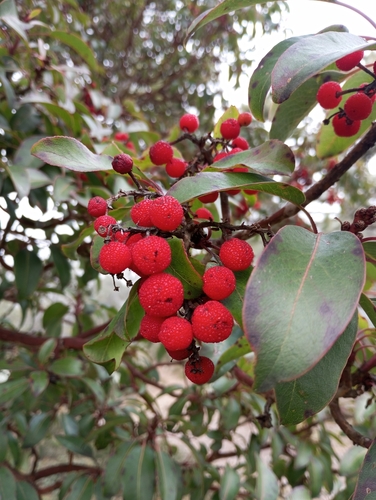
Texas Madrone (Arbutus texana)
At a glance
- Lifecycle
- Perennial (hardy)
- Exposure
- Full sun
- Frost limit
- −12.2 °C
Cultivation
Requires a lime-free nutrient-rich well-drained moisture-retentive soil in sun or semi-shade and shelter from cold drying winds, especially when young. This species is unlikely to be hardy in the colder areas of the country, it probably tolerates temperatures down to between -5 and -10°c. There is some confusion over the name of this plant, some books suggest that A texana is a synonym of A xalapensis. HBK. whilst others say that A texana exists in its own right and has a synonym of A. xalapensis. non HBK.
Propagation
Seed - best surface sown in a cold frame as soon as it is ripe. Stored seed should be soaked for 5 - 6 days in warm water and then surface sown in a shady position in a greenhouse, they are best transplanted to individual pots as soon as they are large enough to handle and should be kept well ventilated. Grow them on in a greenhouse for their first winter and then plant out in late spring after the last expected frosts[K]. Basal cuttings in late winter. Cuttings of mature wood of the current season's growth, November/December in a frame. Poor percentage. Layering of young wood - can take 2 years.
Edible uses
Fruit - raw or cooked. A sweetish taste.
Medicinal uses
The bitter principles in the bark and leaves can be used as an astringent.
Material uses
Wood - heavy, hard, close grained. Used for small tools, mathematical instruments, rollers etc.
Habitat
Dry limestone hills.
Native range
South-western N. America - Texas to New Mexico and south to Mexico.