Astragalus sirinicus
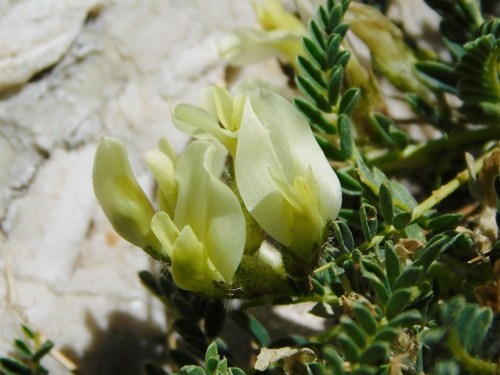
At a glance
- Lifecycle
- Perennial (hardy)
- Exposure
- Full sun
- Frost limit
- −6.7 °C
Cultivation
Succeeds in a hot sunny spot in the rock garden. This species is not very hardy in Britain, but it can be grown outdoors in the mildest parts of the country. Plants are intolerant of root disturbance and are best planted in their final positions whilst still small. This species is very closely related to A. massiliensis, differing mainly in its stems being leafless. This plant is a sub-shrub and although it produces woody stems these tend to die back almost to the base each winter. This species has a symbiotic relationship with certain soil bacteria, these bacteria form nodules on the roots and fix atmospheric nitrogen. Some of this nitrogen is utilized by the growing plant but some can also be used by other plants growing nearby.
Propagation
Seed - best sown as soon as it is ripe in a cold frame. As soon as it is large enough to handle, prick the seedlings out into individual pots and grow them on in the greenhouse for their first winter, planting them out into their permanent positions in late spring or early summer, after the last expected frosts.
Edible uses
A source of gum tragacanth - used as a thickener in confections.
Material uses
Gum tragacanth is obtained from the stem (see above). It has a wide range of uses including:- a thickening agent in preparing dyes for calico printing, textile dyes and for dressing fabrics, it is also a thickener in making glues, water colours, ink (where it supplies a gloss), it is a binding agent in paper making, a culture medium in laboratories etc.
Habitat
Mountains, often in exposed places.
Native range
S. Europe - Italy, Balkans, Corsica and Sardinia.