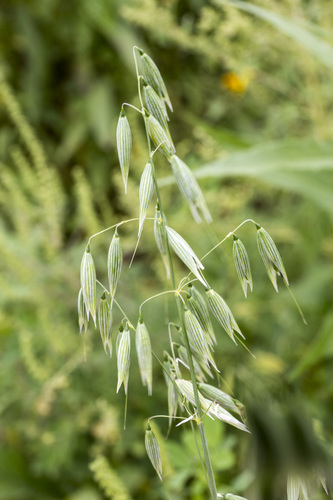
Hungarian Oat (Avena orientalis)
At a glance
- Lifecycle
- Annual
- Exposure
- Full sun
Cultivation
We have very little information on this species, but it should be possible to grow it as a spring-sown annual in Britain, and might also succeed as an autumn-sown crop. Occasionally cultivated for its edible seed, especially in S.E. Europe. The following notes are based on the general needs of the genus. Succeeds in any moderately fertile soil in full sun. Oats are in general easily grown plants but, especially when grown on a small scale, the seed is often completely eaten out by birds. Some sort of netting seems to be the best answer on a garden scale.
Propagation
Seed - sow in situ in early spring or in the autumn. Only just cover the seed. Germination should take place within 2 weeks.
Edible uses
Seed - cooked. The roasted seed is a coffee substitute.
Medicinal uses
The seed is diuretic, emollient and refrigerant.
Material uses
The straw has a wide range of uses such as for bio-mass, fibre, mulch, paper-making and thatching. Some caution is advised in its use as a mulch since oat straw can infest strawberries with stem and bulb eelworm.
Habitat
Dry wasteland, cultivated ground and meadows, especially on heavier soils.
Native range
S. Europe?