Mule's Fat (Baccharis viminea)
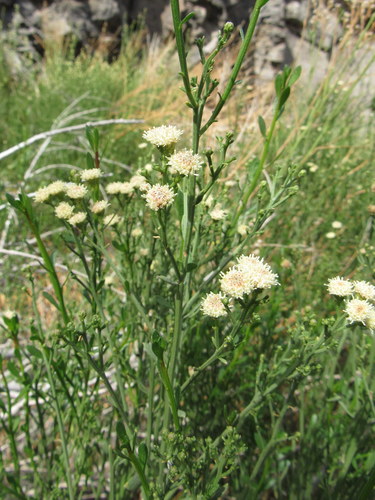
At a glance
- Lifecycle
- Perennial (hardy)
- Exposure
- Full sun
- Frost limit
- −12.2 °C
Cultivation
Succeeds in almost any soil, from heavy clays to pure sands, if it is growing in a sunny position. This species is not hardy in the colder areas of the country, it requires an almost frost-free climate and tolerates temperatures down to between -5 and -10°c. Plants respond well to trimming. Dioecious. Male and female plants must be grown if seed is required.
Propagation
Seed - no pre-treatment is required. When they are large enough to handle, prick the seedlings out into individual pots and grow them on in the cold frame for at least their first winter. Plant them out into their permanent positions in late spring or early summer, after the last expected frosts. Cuttings of half-ripe wood, July/August in a frame. Very easy[K]. Cuttings of mature wood of the current seasons growth, November in a frame. Easy[K].
Edible uses
Young shoots - cooked.
Medicinal uses
A decoction of the leaves and stems has been used as a female hygienic agent. An infusion of the leaves has been used as an eyewash and has also been applied to bruises, wounds or insect stings.
Material uses
An effective ground-cover plant for sunny banks. The plant has an extensive root system and is very useful for stabilizing sand dunes etc. The leaves have been used as a tonic wash for the scalp and hair to prevent baldness. A charcoal made from the stems has been used to make gunpowder.
Habitat
Dry stream beds, ditch banks etc, usually below 450 metres.
Native range
South-western N. America - California to Mexico.