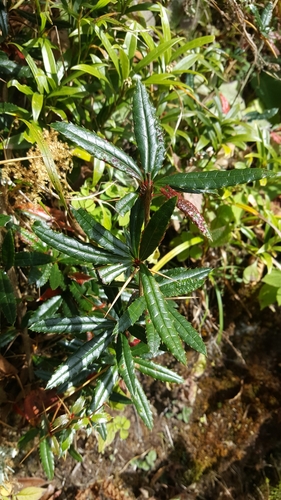
Berberis wallichiana
At a glance
- Lifecycle
- Perennial (hardy)
- Exposure
- Full sun
- Frost limit
- −23.3 °C
Cultivation
Not known
Propagation
Seed - best sown as soon as it is ripe in a cold frame, when it should germinate in late winter or early spring. Cuttings of half-ripe wood, July/August in a frame. Cuttings of mature wood of the current season's growth, preferably with a heel, October/November in a frame. Suckers, removed in late autumn/early winter and planted out in situ or potted up and planted out in late spring.
Edible uses
Fruit - raw.
Medicinal uses
Berberine, universally present in rhizomes of Berberis species, has marked antibacterial effects. Since it is not appreciably absorbed by the body, it is used orally in the treatment of various enteric infections, especially bacterial dysentery.
Material uses
A yellow dye is obtained from the root.
Habitat
Open ground at elevations of 2000 - 3400 metres in Nepal.
Native range
E. Asia - Himalayas to China.