Southern shagbark hickory (Carya carolinae-septentrionalis)
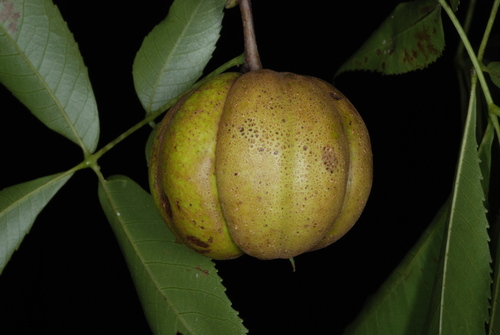
At a glance
- Lifecycle
- Perennial (hardy)
- Exposure
- Full sun
Cultivation
Prefers a deep moisture-retentive loam in a sunny sheltered position, requiring a good summer for best development. Plants are strongly tap-rooted and should be planted in their permanent positions as soon as possible. Trees are late coming into leaf (usually late May to June) and lose their leaves early in the autumn (usually in October). Plants in this genus are notably resistant to honey fungus. Most species in this genus have quite a wide range of distribution and, in order to find trees more suited to this country, seed from the most appropriate provenances should be sought. This species may not be distinct from C. ovata. Trees are self-fertile but larger crops of better quality seeds are produced if cross-pollination takes place.
Propagation
Seed - requires a period of cold stratification. It is best sown in a cold frame as soon as it is ripe (a plastic bottle with the top and bottom removed and a wire mesh top fitted to keep the mice out is ideal)
Edible uses
Seed - raw or cooked. The seed ripens in late autumn and, when stored in its shell in a cool place, will keep for at least 6 months[K].
Material uses
Wood - hard, strong, very tough. Used for tool handles and also makes a very good fuel, giving off a great heat.
Habitat
Dry limestone hills, river bottoms and low flat often inundated woods, especially in clay soils.
Native range
South-eastern N. America - Delaware to Georgia and Tennessee.