Smaller Red-Root (Ceanothus ovatus)
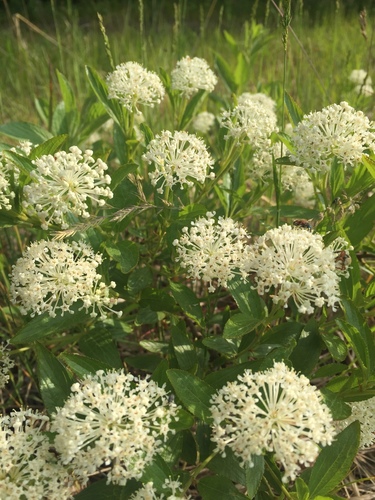
At a glance
- Lifecycle
- Perennial (hardy)
- Exposure
- Full sun
- Frost limit
- −28.9 °C
Cultivation
Prefers a warm sunny position but tolerates light shade. Plants dislike root disturbance, they should be planted out into their permanent positions whilst still small. Dislikes heavy pruning, it is best not to cut out any wood thicker than a pencil. Fast growing, it flowers well when young, often in its second year from seed. Closely related to C. americanus. Some members of this genus have a symbiotic relationship with certain soil micro-organisms, these form nodules on the roots of the plants and fix atmospheric nitrogen. Some of this nitrogen is utilized by the growing plant but some can also be used by other plants growing nearby.
Propagation
Seed - best sown as soon as it is ripe in a cold frame. Stored seed should be pre-soaked for 12 hours in warm water and then given 1 - 3 months stratification at 1°c. Prick out the seedlings into individual pots as soon as they are large enough to handle. Grow them on in the greenhouse for at least their first winter and plant them out into their permanent positions in late spring or early summer. Cuttings of half-ripe wood, taken at a node. Cuttings of mature wood of the current year's growth, 7 - 12 cm with a heel, October in a cold frame. Good percentage.
Edible uses
The young leaves and flowers are steeped in boiling water for about 5 minutes. The resulting liquid is yellowish in colour and tastes similar to Oriental tea but is considered milder and sweeter.
Medicinal uses
A decoction of the roots has been used as a cough remedy.
Material uses
A green dye is obtained from the flowers. All parts of the plant are rich in saponins - when crushed and mixed with water they produce a good lather which is an effective and gentle soap. This soap is very good at removing dirt, though it does not remove oils very well. This means that when used on the skin it will not remove the natural body oils, but nor will it remove engine oil etc[K] The flowers are a very good source, when used as a body soap they leave behind a pleasant perfume on the skin[K]. The developing seed cases are also a very good source of saponins[K].
Habitat
Sandy or rocky plains, prairies and slopes.
Native range
Eastern and Central N. America - western Maine and Quebec to Manitoba, south to Texas.