Bering Sea Spring Beauty (Claytonia acutifolia)
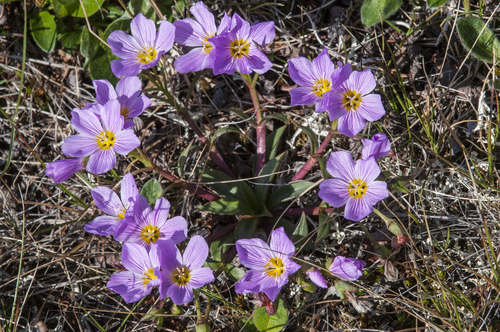
At a glance
- Lifecycle
- Perennial (hardy)
- Exposure
- Full sun
Cultivation
We have very little information on this species and do not know if it will be hardy in Britain, though judging by its native range it should succeed outdoors in many parts of this country. The following notes are based on the general needs of the genus. Requires a damp peaty lime-free soil and a position in full sun.
Propagation
Seed - surface sow on a peat based compost in spring in a cold frame. Germination usually takes place within 2 - 4 weeks at 10°c. When large enough to handle, prick the seedlings out into individual pots and grow them on in the cold frame for at least their first winter. Plant them out in late spring or early summer after the last expected frosts. Division of offsets in spring or autumn.
Edible uses
Root - raw or cooked. Leaves - raw or cooked. Flowers - raw. A nice decoration in a salad.
Habitat
Tundra and stony slopes of bald mountains.
Native range
N. America to Asia in the Arctic circle.
Same genus
- Spring Beauty (Claytonia perfoliata)
- Carolina springbeauty (Claytonia caroliniana)
- Lanceleaf springbeauty (Claytonia lanceolata)
- Alpine springbeauty (Claytonia megarhiza)
- Scamman's springbeauty (Claytonia scammaniana)
- Siberian springbeauty (Claytonia sibirica)
- Tuberous springbeauty (Claytonia tuberosa)
- Great Basin springbeauty (Claytonia umbellata)