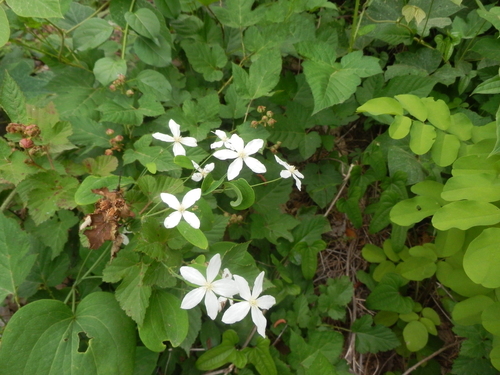
Clematis brachyura
At a glance
- Exposure
- Full sun
- Frost limit
- −23.3 °C
Cultivation
Prefers a deep moist soil with its roots in the shade and its shoots growing up to the light. A twining plant. Flowers are formed from lateral buds produced the previous season. Any pruning should consist of removing any dead or weak growth in early spring and reducing the remainder down to the strongest pair of lateral buds. Plants in this genus are notably resistant to honey fungus. When planting out, in order to avoid the disease 'clematis wilt', it is best to plant the rootball about 8cm deeper in the soil. This will also serve to build up a good root crown of growth buds. Plants seem to be immune to the predations of rabbits. A greedy plant, inhibiting the growth of nearby plants, especially legumes.
Propagation
Seed - best sown as soon as it is ripe in a cold frame. Prick out the seedlings into individual pots when they are large enough to handle and grow them on in a cold frame for the first winter. Plant out in late spring or early summer, after the last expected frosts. Internodal cuttings of soft to semi-ripe wood, late spring in sandy soil in a frame. Layering of old stems in late winter or early spring. Layering of current seasons growth in early summer.
Edible uses
Young leaves - cooked. Some caution is advised, see the notes above on toxicity.
Habitat
Open woodland and shrubberies at elevations around 200 metres.
Native range
E. Asia - Korea.
Same genus
- Traveller's-joy (Clematis vitalba)
- Erect mountain clematis (Clematis albicoma)
- Pine hyacinth (Clematis baldwinii)
- Early virgin's-bower (Clematis cirrhosa)
- Fragrant clematis (Clematis flammula)
- Fremont's leather flower (Clematis fremontii)
- Hairy clematis (Clematis hirsutissima)
- Solitary clematis (Clematis integrifolia)