Clematis buchananiana
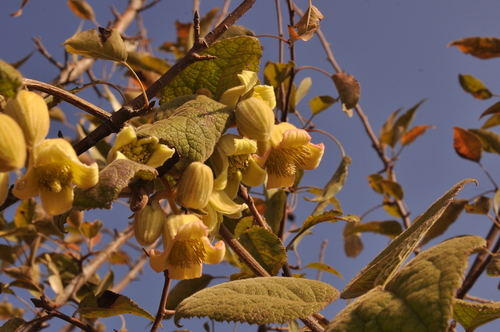
At a glance
- Exposure
- Full sun
- Frost limit
- −17.8 °C
Cultivation
Prefers a deep moist soil with its roots in the shade and its shoots growing up to the light. A very variable species, it varies considerably in hardiness according to the region from which the plant was first obtained - those obtained from the higher limits of its range being more cold-tolerant. A vigorous plant, capable of putting out new shoots up to 4 metres long in a season. A twining plant, the leafstalks wrap themselves around twigs and branches for support. When a side of the stalk touches an object, the growth on that side slows down whilst the other side grows at its normal rate - this causes the leaf stalk to entwine the object it is touching. Plants flower on the current seasons growth. They usually require no pruning, especially if left to clamber into large shrubs and trees. Weak or dead stems can be removed in the winter and, where pruning may be required to reduce the size of the plant, shoots can be cut back by up to two thirds in the winter. When planting out, in order to avoid the disease 'clematis wilt', it is best to plant the rootball about 8cm deeper in the soil. This will also serve to build up a good root crown of growth buds. Plants in this genus are notably resistant to honey fungus. Plants seem to be immune to the predations of rabbits. A greedy plant, inhibiting the growth of nearby plants, especially legumes.
Propagation
Seed - best sown as soon as it is ripe in a cold frame. Prick out the seedlings into individual pots when they are large enough to handle and grow them on in a cold frame for the first winter. Plant out in late spring or early summer, after the last expected frosts. Internodal cuttings of soft to semi-ripe wood, late spring in sandy soil in a frame. Layering of old stems in late winter or early spring. Layering of current seasons growth in early summer.
Edible uses
Tender young leaves - coked as a vegetable. Some caution is advised, see the notes above on toxicity[K]. The plant is used in Nepal to make marcha, a fermented cake from which an alcoholic beverage is distilled.
Medicinal uses
A paste of the roots is used as a poultice to treat swellings caused by inflammation. A paste of the stem or root bark is kept pressed against the teeth for about 15 minutes to relieve toothache. The juice of the plant is applied externally to cuts and wounds. The leaf juice is taken internally, and is also applied externally to the forehead, in the treatment of coughs and colds.
Habitat
Warm broad-leaved to cool mixed forests, forest margins, generally growing on small trees and bushes, occasionally over rocks along the sides of streams at elevations of 460 - 3650 metres.
Native range
E. Asia - Himalayas from Kashmir to Tibet, Burma and western China.
Same genus
- Traveller's-joy (Clematis vitalba)
- Erect mountain clematis (Clematis albicoma)
- Pine hyacinth (Clematis baldwinii)
- Early virgin's-bower (Clematis cirrhosa)
- Fragrant clematis (Clematis flammula)
- Fremont's leather flower (Clematis fremontii)
- Hairy clematis (Clematis hirsutissima)
- Solitary clematis (Clematis integrifolia)