Canadian fleabane (Conyza canadensis)
Other names Canadian horseweed
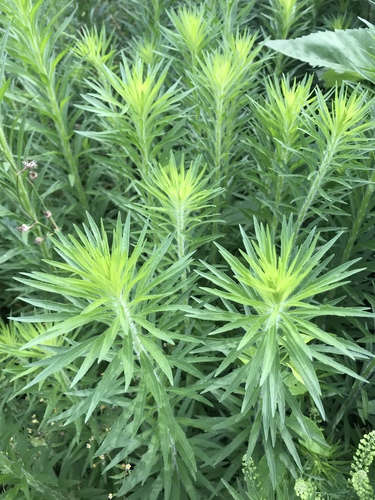
At a glance
- Lifecycle
- Annual
- Exposure
- Full sun
Cultivation
Prefers a well-drained light or medium neutral to alkaline soil in a sunny position, though it tolerates most conditions. Originally from N. America, Canada fleabane has become naturalized in many areas of the world and is considered to be a nuisance weed in many areas. The plant is used commercially as a food flavouring. A good bee plant.
Propagation
Seed - we have no information on this species but suggest sowing the seed in spring in situ. An autumn sowing in situ might also be worthwhile.
Edible uses
Young leaves and seedlings - cooked. The source of an essential oil that is used commercially for flavouring sweets, condiments and soft drinks.
Medicinal uses
In traditional North American herbal medicine, Canada fleabane was boiled to make steam for sweat lodges, taken as a snuff to stimulate sneezing during the course of a cold and burned to create a smoke that warded off insects. The whole plant is antirheumatic, astringent, balsamic, diuretic, emmenagogue, styptic, tonic and vermifuge. An infusion of the plant has been used to treat diarrhoea and internal haemorrhages. The essential oil found in the leaves is used in the treatment of diarrhoea, dysentery and internal haemorrhages. A tea of the boiled roots is used to treat menstrual irregularities. A homeopathic remedy is made from the plant.
Material uses
The plant contains small quantities of essential oil.
Habitat
Light soils on waste and cultivated land, also on walls, avoiding acid soils in Britain.
Native range
N. America. Naturalized in Britain.