Coprosma serrulata
At a glance
- Lifecycle
- Perennial (hardy)
- Exposure
- Full sun
- Frost limit
- −12.2 °C
Cultivation
Requires a moist, very well-drained neutral to slightly acid soil in full sun or light shade. Somewhat intolerant of frost, this species is only likely to succeed outdoors in the milder areas of Britain. Hybridizes freely with other members of this genus. Plants are normally dioecious, though in some species the plants produce a few flowers of the opposite sex before the main flowering and a few hermaphrodite flowers are sometimes produced. Male and female plants must usually be grown if seed is required.
Propagation
Seed - probably best sown as soon as it is ripe in a greenhouse or cold frame[K]. Sow stored seed in spring in a cold frame. Germination can be slow, often taking more than 12 months even when fresh seed is used[K]. When the seedlings are large enough to handle, prick them out into individual pots. Grow on the plants for at least their first winter in a greenhouse and plant out in late spring or early summer. Give the plants some protection from the cold for their first winter outdoors[K]. Cuttings of mature wood of the current year's growth, autumn in a frame.
Edible uses
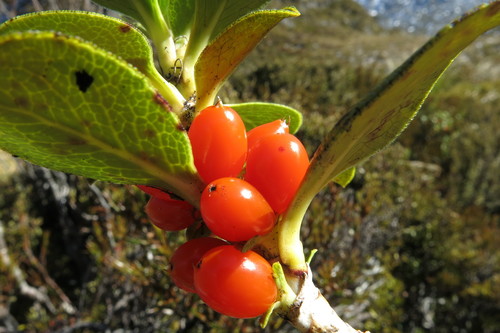
Fruit - raw or cooked. Sweet, but little flavour. The roasted seed is an excellent coffee substitute.
Material uses
A yellow dye is obtained from the wood, it does not require a mordant.
Habitat
Montane to lower sub-alpine forest, shrubland and grassland, from latitude 41° south and southwards on South Island.
Native range
New Zealand.