Black-Wood (Cotoneaster racemiflorus)
Other names cluster-flower cotoneaster
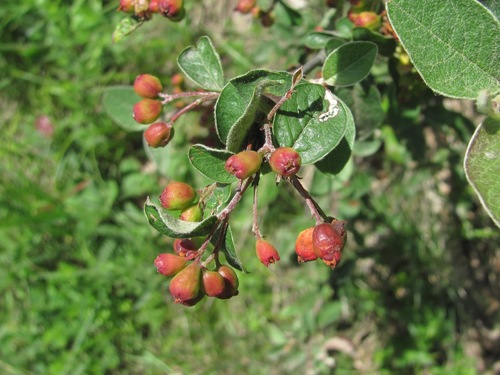
At a glance
- Lifecycle
- Perennial (hardy)
- Exposure
- Full sun
- Frost limit
- −40 °C
Cultivation
An easily grown plant, it prefers a good soil but also does well in poor soils. A very hardy plant, tolerating temperatures down to about -25°c. Hybridizes freely with other members of this genus. The flowers, when inhaled near to, have an unpleasant smell like decaying fish. Trees are notably susceptible to honey fungus.
Propagation
Seed. Members of this genus hybridize freely so, if you require seed that breeds true, it is important to obtain it from a known wild source or from a controlled fertilization of garden plants. The seed is best sown as soon as it is ripe in the autumn in a cold frame, when it will usually germinate in the spring. Pot the seedlings up as soon as they are large enough to handle and plant them out into nursery beds or into their permanent positions when they are more than 10cm tall. Cuttings of half-ripe wood with a heel, July/August in a frame. Cuttings of mature wood of the current year's growth, preferably with a heel, November in a frame.
Edible uses
Yields a manna-like substance called shir-khist, it is rich in sugars. No details of which part of the plant yields the manna, it is most likely to be the stem.
Medicinal uses
The plant is aperient, expectorant and stomachic.
Material uses
A rose-tan dye is obtained from the fruit. The wood is used in basket making.
Habitat
Shrubby thickets on stony slopes.
Native range
N. Africa to W. and C. Asia.