Crataegus baroussana
At a glance
- Lifecycle
- Perennial (hardy)
- Exposure
- Full sun
Cultivation
A very easily grown plant, it prefers a well-drained moisture retentive loamy soil but is not at all fussy. Seedling trees take from 5 - 8 years before they start bearing fruit, though grafted trees will often flower heavily in their third year[K]. The flowers have a foetid smell somewhat like decaying fish. This attracts midges which are the main means of fertilization. When freshly open, the flowers have more pleasant scent with balsamic undertones. Hybridizes freely with other members of this genus. Seedlings should not be left in a seedbed for more than 2 years without being transplanted. This is a species with some potential as a fruit crop in Britain. A native of Mexico, we are not sure how hardy it will be in all parts of Britain, but it is growing and fruiting well at Kew Botanical gardens[K]. A seven year old shrub there in October 1992 was 1.2 metres tall and carrying lots of good sized sweet fruits[K]. It also fruited well in 1993 and 1994, by which time it was 1.4 metres tall[K]. It would appear that this is going to be quite a small species and very suitable as a fruit crop for urban gardens[K].More research is required to find out its hardiness and ultimate size.
Propagation
Seed - this is best sown as soon as it is ripe in the autumn in a cold frame, some of the seed will germinate in the spring, though most will probably take another year. Stored seed can be very slow and erratic to germinate, it should be warm stratified for 3 months at 15°c and then cold stratified for another 3 months at 4°c. If you are only growing small quantities of plants, it is best to pot up the seedlings as soon as they are large enough to handle and grow them on in individual pots for their first year, planting them out in late spring into nursery beds or their final positions. When growing larger quantities, it might be best to sow them directly outdoors in a seedbed, but with protection from mice and other seed-eating creatures. Grow them on in the seedbed until large enough to plant out, but undercut the roots if they are to be left undisturbed for more than two years.
Edible uses
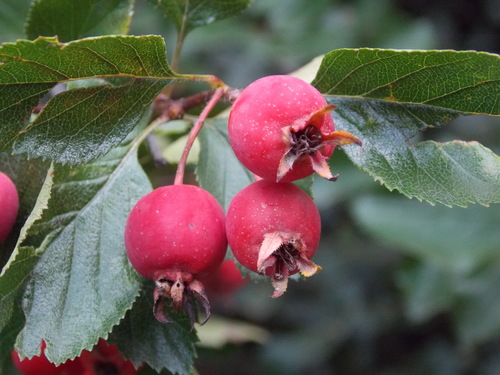
Fruit - raw or cooked. Sweet and quite a good size for a Crataegus[K]. It makes a very acceptable dessert fruit and can also be cooked in pies, preserves etc[K]. There are up to five fairly large seeds in the centre of the fruit, these often stick together and so the effect is of eating a cherry-like fruit with a single seed[K].
Medicinal uses
Although no specific mention has been seen for this species, the fruits and flowers of many hawthorns are well-known in herbal folk medicine as a heart tonic and modern research has borne out this use. The fruits and flowers have a hypotensive effect as well as acting as a direct and mild heart tonic.
Material uses
Wood - heavy, hard, tough, close-grained. Useful for making tool handles, mallets and other small items.
Habitat
Only found in one habitat, at elevations around 2100 metres in the mountains of Coahuila.
Native range
Southern N. America - Mexico.