Elaeagnus glabra
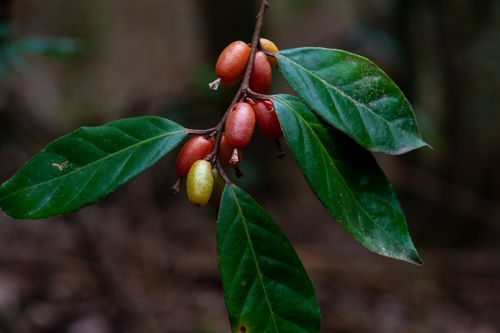
At a glance
- Lifecycle
- Perennial (hardy)
- Exposure
- Full sun
- Frost limit
- −12.2 °C
Cultivation
Succeeds in most soils that are well-drained. Plants are not reliably hardy in the colder areas of the country. This species has some potential as a commercial crop in temperate areas. It does not always carry a good crop, and research needs to be carried out to find the reasons for it, but the fruit is of a reasonable size and, when fully ripe, of a reasonable flavour[K]. It seems to be the latest to ripen in spring of the evergreen Elaeagnus[K]. Closely related to E. pungens, differing in its unarmed branches and thinner more glossy leaves. This species is notably resistant to honey fungus. This species has a symbiotic relationship with certain soil bacteria, these bacteria form nodules on the roots and fix atmospheric nitrogen. Some of this nitrogen is utilized by the growing plant but some can also be used by other plants growing nearby. An excellent companion plant, when grown in orchards it can increase yields from the fruit trees by up to 10%. The small flowers are deliciously scented, their aroma pervading the garden on calm days[K].
Propagation
Seed - best sown as soon as it is ripe in a cold frame. Prick out the seedlings into individual pot as soon as they are large enough to handle and plant out when they are at least 15cm tall. Cuttings of half-ripe wood, 7 - 10cm with a heel, July/August in a frame. Good percentage. Cuttings of mature wood of the current year's growth, 10 - 12cm with a heel, November in a frame. Leave for 12 months. Fair to good percentage. Layering in September/October. Takes 12 months.
Edible uses
Fruit - raw or cooked and contains a single large seed[K]. Seed - raw or cooked. It can be eaten with the fruit though the seed case is rather fibrous[K].
Medicinal uses
The fruit of many members of this genus is a very rich source of vitamins and minerals, especially in vitamins A, C and E, flavanoids and other bio-active compounds. It is also a fairly good source of essential fatty acids, which is fairly unusual for a fruit. It is being investigated as a food that is capable of reducing the incidence of cancer and also as a means of halting or reversing the growth of cancers.
Material uses
Plants can be grown as a hedge in exposed positions, tolerating maritime exposure.
Habitat
Thickets in hills.
Native range
E. Asia - China, Japan.