Couch-grass (Elytrigia repens)
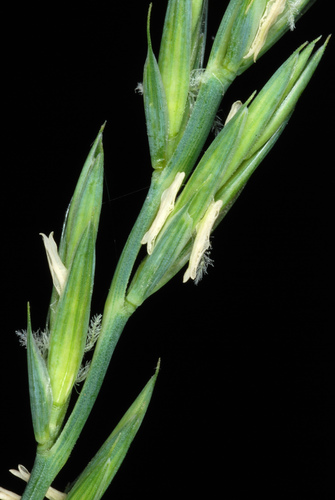
At a glance
- Lifecycle
- Perennial (hardy)
- Exposure
- Full sun
Cultivation
Couch grass can succeed in any soil, though it grows best in light sandy soils. It is a rapidly spreading, persistent and pernicious weed that should only be introduced with great caution. It tolerates a pH in the range 4.2 to 8.3. Some modern works have now separated this species off into a new genus as Elytrigia repens. A food plant for the caterpillars of many butterfly and moth species. This species can become a pernicious weed, spreading rapidly by underground rhizomes.
Propagation
This species is a pernicious weed and will not require assistance in spreading itself.
Edible uses
Roots - cooked. They can be dried and ground into a powder, then used with wheat when making bread. The roasted root is a coffee substitute. Young leaves and shoots - eaten raw in spring salads. Seed. The seed is very small and there is a large husk surrounding it, so that effectively it is more like eating fibre than cereal[K].
Medicinal uses
Couch grass is of considerable value as a herbal medicine, the roots being very useful in the treatment of a wide range of kidney, liver and urinary disorders. The roots are antiphlogistic, aperient, demulcent, diuretic, emollient, lithontripic and tonic. A tea made from the roots is used in cases of urinary incompetence and as a worm expellent.
Material uses
An infusion of the whole plant is a good liquid plant feed. The plant has a long creeping root system and so it has been planted in sand dunes near the coast to bind the soil together. A grey dye is obtained from the roots.
Habitat
A common weed of gardens, fields, hedgerows and meadows.
Native range
Most of Europe, including Britain, N. Africa, Siberia and N. America.