Ma huang (Ephedra equisetina)
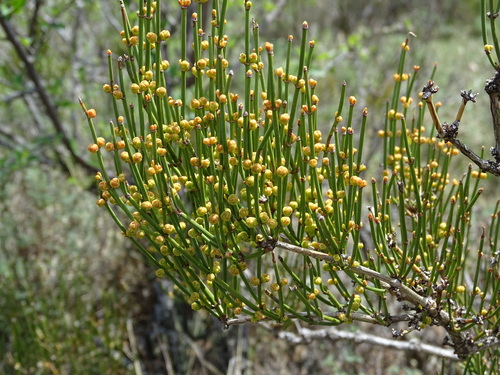
At a glance
- Lifecycle
- Perennial (hardy)
- Exposure
- Full sun
Cultivation
We have very little information on this species and do not know if it will be hardy in Britain, though judging by its native range it should succeed outdoors in many parts of this country. The following notes are based on the general needs of the genus. Requires a well-drained loamy soil and a sunny position. Dioecious, male and female plants must be grown in fruit and seed are required.
Propagation
Seed - best sown as soon as it is ripe in the autumn in a greenhouse. It can also be sown in spring in a greenhouse in a sandy compost[K]. Prick out the seedlings into individual pots as soon as they are large enough to handle and grow them on for at least their first winter in a greenhouse. Plant out in the spring or early summer after the last expected frosts and give some protection in their first winter[K]. Division in spring or autumn. Layering.
Edible uses
Fruit - raw.
Medicinal uses
Members of this genus contain various medicinally active alkaloids (but notably ephedrine) and they are widely used in preparations for the treatment of asthma and catarrh. The stems are a pungent, bitter, warm herb that dilates the bronchial vessels whilst stimulating the heart and central nervous system. Ephedrine is seen as a performance-boosting herb and, as such, is a forbidden substance in many sporting events such as athletics[K]. The stems can be harvested at any time of the year and are dried for later use. The root is antihydrotic, it lowers blood pressure and dilates the peripheral blood vessels.
Habitat
Mountains in central and middle Asia.
Native range
E. Asia - N. China.