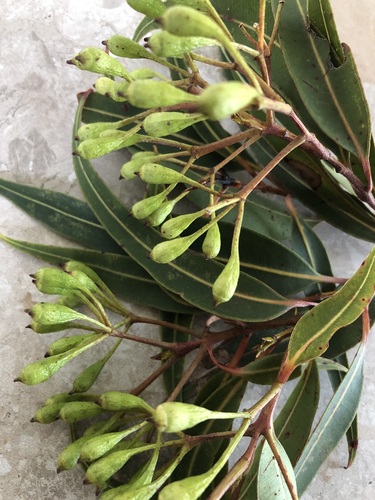
Red Bloodwood (Eucalyptus gummifera)
At a glance
- Lifecycle
- Perennial (hardy)
- Exposure
- Full sun
- Frost limit
- −1.1 °C
Cultivation
Prefers a sunny position in a moderately fertile well-drained moisture retentive circum-neutral soil. This species is hardy to at least -7°c in Australian gardens according to one report. Plants are not likely to be very cold tolerant in Britain, provenances from the higher parts of its range in Tasmania are more likely to succeed. Eucalyptus species have not adopted a deciduous habit and continue to grow until it is too cold for them to do so. This makes them more susceptible to damage from sudden cold snaps. If temperature fluctuations are more gradual, as in a woodland for example, the plants have the opportunity to stop growing and become dormant, thus making them more cold resistant. A deep mulch around the roots to prevent the soil from freezing also helps the trees to survive cold conditions. Eucalyptus monocultures are an environmental disaster, they are voracious, allelopathic and encourage the worst possible attitudes to land use and conservation. Plants are shallow-rooting and, especially in windy areas, should be planted out into their permanent positions when small to ensure that they do not suffer from wind-rock. The flowers are rich in nectar and are a good bee crop.
Propagation
Seed - surface sow February/March in a sunny position in a greenhouse.
Edible uses
The flowers produce copious amounts of nectar which can be sucked from the flowers or mixed with water to make a sweet drink that is called 'bool' in Australia.
Medicinal uses
Eucalyptus leaves are a traditional Aboriginal herbal remedy. The essential oil found in the leaves is a powerful antiseptic and is used all over the world for relieving coughs and colds, sore throats and other infections. An essential oil obtained from the leaves is antiseptic, astringent and parasiticide. An oleo- resin is exuded from the tree.
Material uses
This tree might be suitable as a windbreak near the coast. Wood - red, hard, very durable in the soil, but it has gum streaks and veins. Rarely attacked by white ants, it is used mainly as a fuel, for which it is very good.
Habitat
Sandy gravelly to loamy sandy soils by the coast and up to 1000 metres. Dry sclerophyll forests, mainly on sandstone soils but also sometimes on shales.
Native range
Australia - New South Wales, Tasmania, Victoria.