Perennial Buckwheat (Fagopyrum dibotrys)
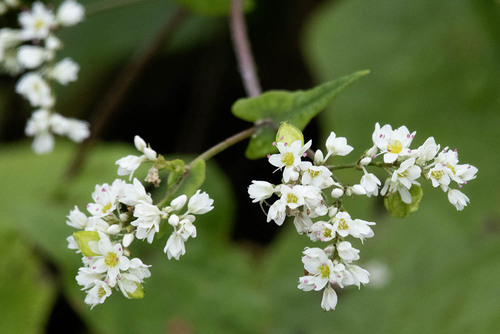
At a glance
- Lifecycle
- Perennial (hardy)
- Exposure
- Full sun
Cultivation
A very tolerant and easily grown plant, it prefers dry sandy soils but succeeds in most conditions including poor, heavy or acid soils and even sub-soils. Prefers a good soil in partial shade, growing very well in woodland conditions[K]. The dormant plant is hardy to about -20°c, though the growing plant is frost tender[K]. It is often excited into growth quite early in the year if the weather is mild, and will then be cut back by the first frost. It usually regrows quickly from the base[K]. Perennial buckwheat is occasionally cultivated for its edible seed, though this is not produced as abundantly as in the annual members of this genus[K]. Our plants flower in late summer and early autumn, and have not as yet produced any seed. Since all our plants come originally from one seedling, it is quite possible that the plant is self-sterile[K]. There is at least one named variety, selected for its ornamental value. 'Variegata' has variegated leaves.
Propagation
Seed - sow spring in a greenhouse. Prick out the seedlings when they are large enough to handle and plant them out into their permanent positions in the summer. Division is very easy at almost any time in the growing season, though it is best avoided in early spring because the young growth can be damaged by late frosts. The divisions can be planted out direct into their permanent positions.
Edible uses
Leaves - raw or cooked, but we have been less than impressed by the flavour, which has a distinct bitterness especially when eaten raw[K]. The leaves are rich in rutin (see below for details of its uses) and so they do make a healthy addition to the diet[K]. Seed - it can be sprouted and eaten raw, or cooked and used as a cereal.
Medicinal uses
The whole plant is anodyne, anthelmintic, antiphlogistic, carminative, depurative and febrifuge. It stimulates blood circulation. A decoction of the roots is used in the treatment of insect bites, dysmenorrhoea, inflammation, lumbago, snakebite and traumatic injuries. The leaves are rich in rutin which is a capillary tonic, antioedemic, anti-inflammatory, antispasmodic and hypotensive.
Habitat
Forests and cultivated areas from Pakistan to S.W. China, 1500 - 3400 metres.
Native range
E. Asia - China, Japan, Himalayas.
Scientific synonyms Fagopyrum cymosum