Nepalese Crane's Bill (Geranium nepalense)
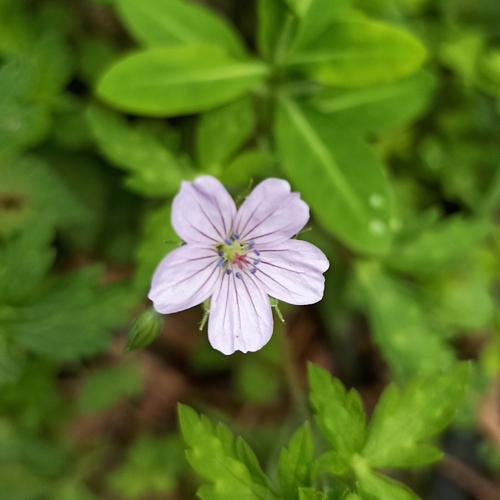
At a glance
- Lifecycle
- Perennial (hardy)
- Exposure
- Full sun
- Frost limit
- −17.8 °C
Cultivation
Succeeds in any moderately fertile retentive soil in a sunny position. Members of this genus are rarely if ever troubled by browsing deer or rabbits.
Propagation
Seed - sow spring in a cold frame. When they are large enough to handle, prick the seedlings out into individual pots and plant them out in the summer. Division in spring or autumn. Larger clumps can be replanted direct into their permanent positions, though it is best to pot up smaller clumps and grow them on in a cold frame until they are rooting well. Plant them out in the spring.
Edible uses
Leaves. No further details are given. Fruits - chewed fresh. The fruit is a small dry capsule[K].
Medicinal uses
The whole plant is antibacterial and astringent.
Material uses
A red dye is obtained from the root, it is similar to Rubia cordifolia. The root contains 25 - 32% tannins.
Habitat
Semi-shaded scrubby slopes and in forests, 1500 - 2300 metres in the Himalayas.
Native range
E. Asia - China to the Himalayas.
Same genus
- Herb-Robert (Geranium robertianum)
- Bicknell's cranesbill (Geranium bicknellii)
- Pineywoods geranium (Geranium caespitosum)
- California cranesbill (Geranium californicum)
- Carolina crane's-bill (Geranium carolinianum)
- Longstalk cranesbill (Geranium columbinum)
- Cutleaf geranium (Geranium dissectum)
- Fanleaf geranium (Geranium divaricatum)