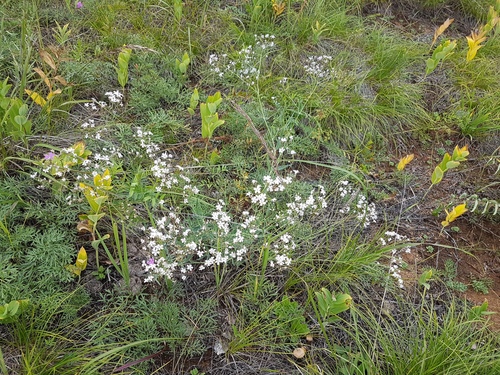
Gypsophila davurica
At a glance
- Lifecycle
- Perennial (hardy)
- Exposure
- Full sun
Cultivation
We have very little information on this species and do not know if it will be hardy in Britain, though judging by its native range it should succeed outdoors in at least the milder areas of this country. It is likely to require a dry, sunny position in a well-drained soil[K]. The following notes are based on the general needs of the genus. Requires a well-drained soil in full sun.
Propagation
Seed - we have no information for this species but suggest sowing the seed in a greenhouse in spring. When they are large enough to handle, prick the seedlings out into individual pots and, if growth is sufficient, plant them out into their permanent positions in the summer. If the plants are too small to plant out, grow them on in the greenhouse for their first winter and then plant them out in late spring or early summer. Division in spring or autumn. Larger clumps can be replanted direct into their permanent positions, though it is best to pot up smaller clumps and grow them on in a cold frame until they are rooting well. Plant them out in the spring. Basal cuttings before the plant flowers. Harvest the shoots when they are about 10cm long with plenty of underground stem. Pot them up into individual pots and keep them in light shade in a cold frame or greenhouse until they are rooting well. Plant them out in the summer. Root cuttings.
Edible uses
Root - cooked. It requires treatment and is used as an emergency food when all else fails. The type of treatment is not given, it is likely to be some sort of leaching or a long cooking period in order to remove or destroy saponins[K].
Habitat
Steppe meadows and gravelly steppe slopes.
Native range
E. Asia - Northern China, Mongolia, Siberia.
Same genus
- Showy baby's-breath (Gypsophila elegans)
- Sharpleaf baby's-breath (Gypsophila acutifolia)
- Chickweed baby's-breath (Gypsophila cerastoides)
- Oldham's baby's-breath (Gypsophila oldhamiana)
- Baby's breath (Gypsophila paniculata)
- Perfoliate baby's-breath (Gypsophila perfoliata)
- Pacific gypsophila (Gypsophila pacifica)
- Turkish baby's-breath (Gypsophila pilosa)