Showy Sunflower (Helianthus laetiflorus)
Other names Perennial Sunflower, beautiful sunflower, cheerful sunflower, mountain sunflower
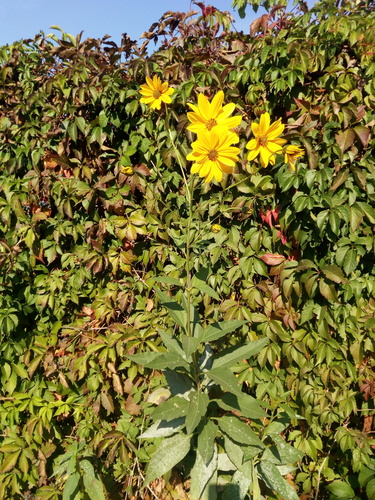
At a glance
- Lifecycle
- Perennial (hardy)
- Exposure
- Full sun
- Frost limit
- −34.4 °C
Cultivation
Succeeds in most soils in a sunny position. The young growth is extremely attractive to slugs, plants can be totally destroyed by them[K]. Members of this genus are rarely if ever troubled by browsing deer or rabbits. A naturally occurring hybrid, H. pauciflorus (or H. rigidus in another report) x H. tuberosus. Plants have a running root system and can be very invasive. This species is often grown as an ornamental plant, there are several named varieties.
Propagation
Seed - sow spring in a cold frame. When they are large enough to handle, prick the seedlings out into individual pots and grow them on in the greenhouse for their first winter. Plant them out into their permanent positions in late spring or early summer, after the last expected frosts. Division in spring or autumn. Very easy, larger clumps can be replanted direct into their permanent positions, though it is best to pot up smaller clumps and grow them on in a cold frame until they are rooting well. Plant them out in the spring. Basal cuttings in spring. Harvest the shoots when they are about 10 - 15cm long with plenty of underground stem. Pot them up into individual pots and keep them in light shade in a cold frame or greenhouse until they are rooting well. Plant them out in the summer.
Edible uses
Tubers - raw or cooked[55, 105, K]. Used like Jerusalem artichokes, to which they are not much inferior in taste though yields are lower.
Habitat
Open woods and thickets, often on drier soils.
Native range
Central N. America - Pennsylvania to Minnesota.
Same genus
- Sunflower (Helianthus annuus)
- Helianthus maximilliani
- Fewleaf sunflower (Helianthus occidentalis)
- Jerusalem artichoke (Helianthus tuberosus)
- Southeastern sunflower (Helianthus agrestis)
- Swamp sunflower (Helianthus angustifolius)
- Western sunflower (Helianthus anomalus)
- Silverleaf sunflower (Helianthus argophyllus)