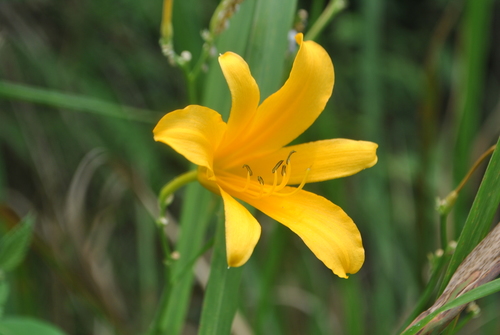
Hemerocallis plicata
At a glance
- Lifecycle
- Perennial (hardy)
- Exposure
- Full sun
Cultivation
Succeeds in most soils. The string-like roots have spindle-shaped swellings near their ends. Hybridizes freely with other members of this genus. Plants take a year or two to become established after being moved. Plants seem to be immune to the predations of rabbits. The plants are very susceptible to slug and snail damage, the young growth in spring is especially at risk.
Propagation
Seed - sow in the middle of spring in a greenhouse. Germination is usually fairly rapid and good. Prick out the seedlings into individual pots when they are large enough to handle. Grow the plants on for their first winter in a greenhouse and plant out in late spring[K]. Division in spring or after flowering in late summer or autumn. Division is very quick and easy, succeeding at almost any time of the year[K]. Larger clumps can be replanted direct into their permanent positions, though it is best to pot up smaller clumps and grow them on in a cold frame until they are rooting well. Plant them out in the spring.
Edible uses
Leaves and young shoots - cooked. They must be consumed when very young or else they become fibrous[K]. Flowers and flower buds - raw or cooked. Root - raw or cooked. A radish-like flavour, but not so sharp.
Medicinal uses
The juice of the roots is an effective antidote in cases of arsenic poisoning. A tea made from the boiled roots is used as a diuretic.
Material uses
The tough dried foliage is plaited into cord and used for making footwear.
Habitat
Sub-alpine woods and alpine meadows.
Native range
E. Asia - S.W. and W. China.