Chinese Hibiscus (Hibiscus rosa-sinensis)
Other names Hibiscus, Shoeblackplant
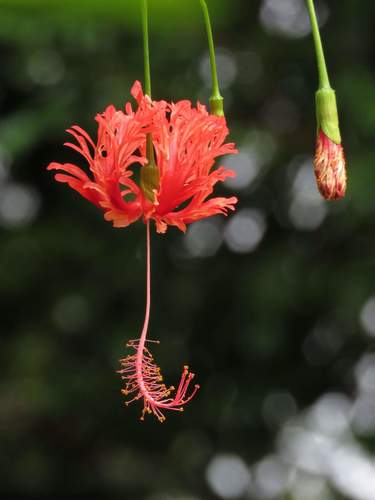
At a glance
- Lifecycle
- Perennial (hardy)
- Exposure
- Full sun
- Frost limit
- −6.7 °C
Cultivation
Prefers a well-drained humus rich fertile soil in a warm, sheltered position in full sun. A very ornamental plant. Plants will often lose most of their leaves in cool winters, though they will normally regenerate quickly as the warmer weather returns. The flowers of Chinese hibiscus are very important in Hindu devotional ceremonies, being sacred to the Elephant God, Ganesh. There are many named forms, selected for their ornamental value.
Propagation
Seed - sow early spring in a warm greenhouse. Germination is usually fairly rapid. Prick out the seedlings into individual pots when they are large enough to handle. If growing them as annuals, plant them out into their permanent positions in early summer and protect them with a frame or cloche until they are growing away well. If hoping to grow them as perennials, then it is better to grow them on in the greenhouse for their first year and to plant them out in early summer of the following year. Cuttings of half-ripe wood, July/August in a frame. Overwinter them in a warm greenhouse and plant out after the last expected frosts.
Edible uses
Young leaves are sometimes used as a spinach substitute. Flowers - raw or cooked. Root - it is edible but very fibrousy.
Medicinal uses
Chinese hibiscus is a sweet, astringent, cooling herb that checks bleeding, soothes irritated tissues and relaxes spasms. The flowers are aphrodisiac, demulcent, emmenagogue, emollient and refrigerant. The leaves are anodyne, aperient, emollient and laxative. The leaves and flowers are beaten into a paste and poulticed onto cancerous swellings and mumps. The root is a good source of mucilage and is used as a substitute for marsh mallow (Althaea officinalis) in the treatment of coughs and colds.
Material uses
The juice from the petals is used in China as shoe-blacking and mascara. A good quality fibre is obtained from the stems. Plants are often used for hedges and screens, though since they are not very cold hardy they are not suitable for this use in Britain.
Habitat
Not known in a truly wild situation
Native range
S. E. Asia.
Same genus
- Roselle (Hibiscus sabdariffa)
- Rose of Sharon (Hibiscus syriacus)
- Fork-bracted rosemallow (Hibiscus bifurcatus)
- Arizona rosemallow (Hibiscus biseptus)
- Brown Indianhemp (Hibiscus cannabinus)
- Scarlet rosemallow (Hibiscus coccineus)
- Neches River rosemallow (Hibiscus dasycalyx)
- Lindenleaf rosemallow (Hibiscus furcellatus)