Chinese Sea Buckthorn (Hippophae sinensis)
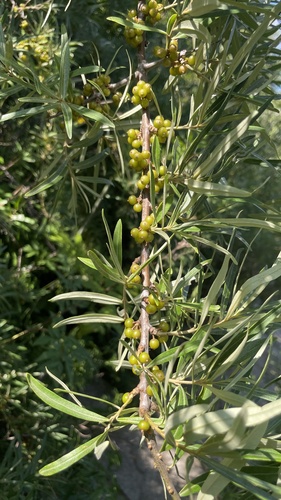
At a glance
- Lifecycle
- Perennial (hardy)
- Exposure
- Full sun
Cultivation
Succeeds in most soils if they are not too dry. Members of this genus are attracting considerable interest from breeding institutes for their nutrient-rich fruits that can promote the general health of the body (see edible and medicinal uses below). This species is closely related to H. rhamnoides, differing in its cruciform buds in winter and its fruits which are higher in vitamin C. Plants in this genus are notably resistant to honey fungus. This species has a symbiotic relationship with certain soil bacteria, these bacteria form nodules on the roots and fix atmospheric nitrogen. Some of this nitrogen is utilized by the growing plant but some can also be used by other plants growing nearby. Dioecious. Male and female plants must be grown if seed is required.
Propagation
Seed - sow spring in a sunny position in a cold frame. Cuttings of half-ripe wood, June/July in a frame. Cuttings of mature wood in autumn. Division of suckers in the winter. They can be planted out direct into their permanent positions and usually establish well and quickly[K]. Layering in autumn.
Edible uses
Fruit - raw or cooked.
Medicinal uses
The tender branches and leaves contain bio-active substances which are used to produce an oil that is quite distinct from the oil produced from the fruit. This oil is used as an ointment for treating burns. A high-quality medicinal oil is made from the fruit and used in the treatment of cardiac disorders, it is also said to be particularly effective when applied to the skin to heal burns, eczema and radiation injury, and is taken internally in the treatment of stomach and intestinal diseases. The fruit is a very rich source of vitamins and minerals, especially in vitamins A, C and E, flavanoids and other bio-active compounds. It is also a fairly good source of essential fatty acids, which is fairly unusual for a fruit. It is being investigated as a food that is capable of reducing the incidence of cancer and also as a means of halting or reversing the growth of cancers.
Material uses
The wood is used for fuel.
Habitat
Open sunny places between 800 and 3600 metres.
Native range
E. Asia - W. China.