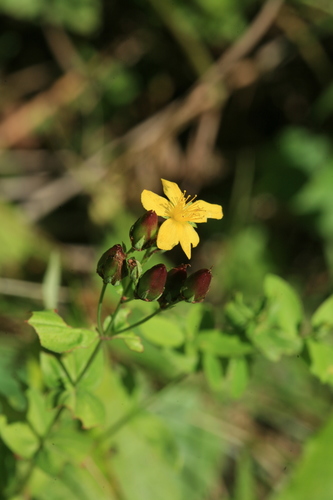
Hypericum erectum
At a glance
- Lifecycle
- Perennial (hardy)
- Exposure
- Full sun
- Frost limit
- −23.3 °C
Cultivation
Easily grown in any reasonably good well-drained but moisture retentive soil. One report says that the plant is vigorous but not quite hardy in Britain.
Propagation
Seed - sow spring in a greenhouse and only just cover the seed. Germination usually takes place within 1 - 3 months at 10°c. When they are large enough to handle, prick the seedlings out into individual pots and grow them on in the greenhouse for their first winter. Plant them out into their permanent positions in late spring or early summer, after the last expected frosts. Division in spring. Larger clumps can be replanted direct into their permanent positions, though it is best to pot up smaller clumps and grow them on in a cold frame until they are rooting well. Plant them out in the spring.
Edible uses
Leaves and stems. No more details.
Medicinal uses
The leaves and flowering tops are galactogogue. The stems are rich in tannin and are used in the treatment of arthritis, lumbago, neuralgia and rheumatism.
Habitat
Grassy places and thin woods in hills and mountains all over Japan.
Native range
E. Asia - China, Japan, Korea.
Same genus
- St. Johnswort (Hypericum perforatum)
- Tinker's penny (Hypericum anagalloides)
- Orangegrass (Hypericum gentianoides)
- Trailing St. Johnswort (Hypericum humifusum)
- Large St. Johnswort (Hypericum majus)
- Dwarf St. Johnswort (Hypericum mutilum)
- Slender St John's-wort (Hypericum pulchrum)
- Great St. Johnswort (Hypericum ascyron)