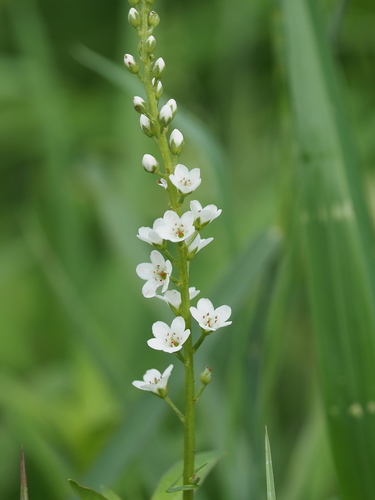
Lysimachia fortunei
At a glance
- Lifecycle
- Perennial (hardy)
- Exposure
- Full sun
- Frost limit
- −17.8 °C
Cultivation
An easily grown plant, succeeding in a moist loamy soil. Judging by its native habitat, it should succeed in shallow water. Grows well in heavy clay soils. Most species in this genus seem to be immune to the predations of rabbits.
Propagation
Seed - sow autumn in a cold frame. When they are large enough to handle, prick the seedlings out into individual pots and plant them out in the summer. Division in spring or autumn. Larger clumps can be replanted direct into their permanent positions, though it is best to pot up smaller clumps and grow them on in a cold frame until they are rooting well. Plant them out in the spring.
Edible uses
The young plant is edible.
Habitat
Wet margins of rivers and ponds in the lowland of C. and S. Japan.
Native range
E. Asia - China, Japan.
Same genus
- Scarlet pimpernel (Lysimachia arvensis)
- Chaffweed (Lysimachia minima)
- Bog pimpernel (Lysimachia tenella)
- Sea-milkwort (Lysimachia maritima)
- Roughleaf yellow loosestrife (Lysimachia asperulifolia)
- Gooseneck yellow loosestrife (Lysimachia clethroides)
- Fraser's yellow loosestrife (Lysimachia fraseri)
- Grassleaf yellow loosestrife (Lysimachia graminea)