Wharariki (Phormium cookianum)
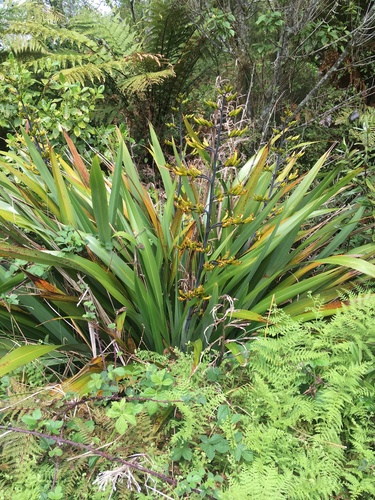
At a glance
- Lifecycle
- Perennial (hardy)
- Exposure
- Full sun
- Frost limit
- −12.2 °C
Cultivation
Prefers a rich loamy soil. Hardy to about -10°c. Polymorphic, there are many named varieties. This species often hybridizes with P. tenax and there are many cultivars of uncertain origin. Members of this genus are rarely if ever troubled by browsing deer or rabbits.
Propagation
The seed is best sown as soon as it is ripe in a cold frame. Sow stored seed in February in a cold frame. Germination is sometimes poor but should take place in 1 - 6 months at 15°c. The seedlings are very variable. When they are large enough to handle, prick the seedlings out into individual pots and grow them on in the greenhouse for at least their first winter. Plant them out into their permanent positions in late spring or early summer, after the last expected frosts. The seed remains viable for about 12 months in normal storage. Division in spring as growth commences. Very easy, larger divisions can be planted out direct into their permanent positions. We have found that it is better to pot up the smaller divisions and grow them on in light shade in a cold frame until they are well established before planting them out in late spring or early summer.
Edible uses
The roasted seed is used as a coffee substitute. An edible nectar is obtained from the flowers. An edible gum is obtained from the base of the leaves.
Material uses
A high quality pliable fibre is obtained from the leaves. A gum found at the base of the leaves is used as a paper glue.
Habitat
Coastal cliffs to mountain slopes, locally dominant on shady faces in high country, North, South and Stewart Islands.
Native range
New Zealand. Naturalized in Britain on the Scilly Isles.