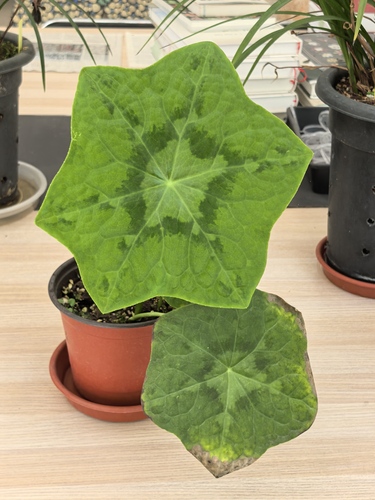
Podophyllum aurantiocaule
At a glance
- Lifecycle
- Perennial (hardy)
- Exposure
- Full shade
- Frost limit
- −17.8 °C
Cultivation
Prefers a moist peaty soil and filtered light or shade. Plants are fairly hardy, but the new growth in spring is frost tender. Plants in this genus have excited quite a lot of interest for the compounds found in their roots which have been shown to have anti-cancer activity. This species is closely related to P. hexandrum. he plant takes some years to become established.
Propagation
Seed - best sown as soon as it is ripe in a cold frame. Sow stored seed in a cold frame in early spring. The seed germinates in 1 - 4 months at 15°c. Prick out the seedlings into individual pots when they are large enough to handle and grow on in a shady part of the greenhouse for at least 2 growing seasons. Plant them out into their permanent positions in the winter when the plants are dormant. Division in March/April.
Edible uses
We have no reports for this species but the following report is for the closely related P. hexandrum. Fruit - raw. It must only be eaten when it is fully ripe.
Medicinal uses
The following report is for the related P. hexandrum. It quite probably also applies to this species. The whole plant, but especially the root, is cholagogue, cytostatic and purgative. The plant contains podophyllin, which has an antimyotic effect (it interferes with cell division and can thus prevent the growth of cells). It is, therefore, a possible treatment for cancer, and has been used especially in the treatment of ovarian cancer. The roots contain several important anti-cancer lignans, including podophyllin and berberine. The root is harvested in the autumn and either dried for later use or the resin is extracted.
Habitat
Not known
Native range
E. Asia - China.