Potamogeton oxyphyllus
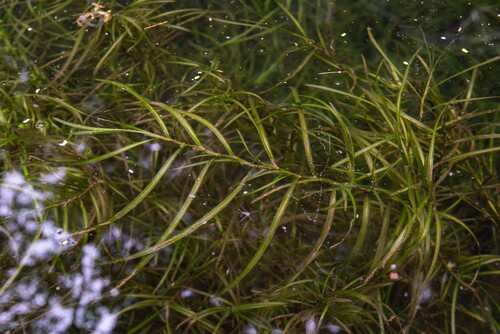
At a glance
- Lifecycle
- Perennial (hardy)
- Exposure
- Full sun
Cultivation
We have very little information on this species and do not know if it will be hardy in this country, though judging by its native range it should succeed outdoors in much of the country. The following notes are based on the general needs of the genus. A submerged aquatic plant that can be used as an oxygenator of ponds. A fast growing plant in need of constant checking to make sure it does not overrun the pond. Hybridizes freely with other members of this genus, the resulting progeny is usually sterile.
Propagation
Seed - we have no information for this species but suggest sowing the seed in a pot that is standing in its own depth of water in a greenhouse as soon as the seed is ripe if this is possible. Stored seed is likely to have a short viability. Prick out the seedlings when they are large enough to handle and increase the depth of water around the pot until the plants are covered by a few centimetres of water. Grow the plants on in a sunny position in the greenhouse for their first winter, increasing the depth of water as the plants grow larger. Plant them out into their permanent positions in early summer. Division in spring. Cuttings of erect shoots in the growing season.
Edible uses
Leaves and stems. No more details are given. Young root. No more details are given.
Habitat
Ponds and shallow rivers all over Japan.
Native range
E. Asia - Japan, Korea.
Same genus
- Alpine pondweed (Potamogeton alpinus)
- Largeleaf pondweed (Potamogeton amplifolius)
- Curly pondweed (Potamogeton crispus)
- Variableleaf pondweed (Potamogeton gramineus)
- Broad-leaved pondweed (Potamogeton natans)
- Loddon pondweed (Potamogeton nodosus)
- Blunt-leaved pondweed (Potamogeton obtusifolius)
- Small pondweed (Potamogeton pusillus)