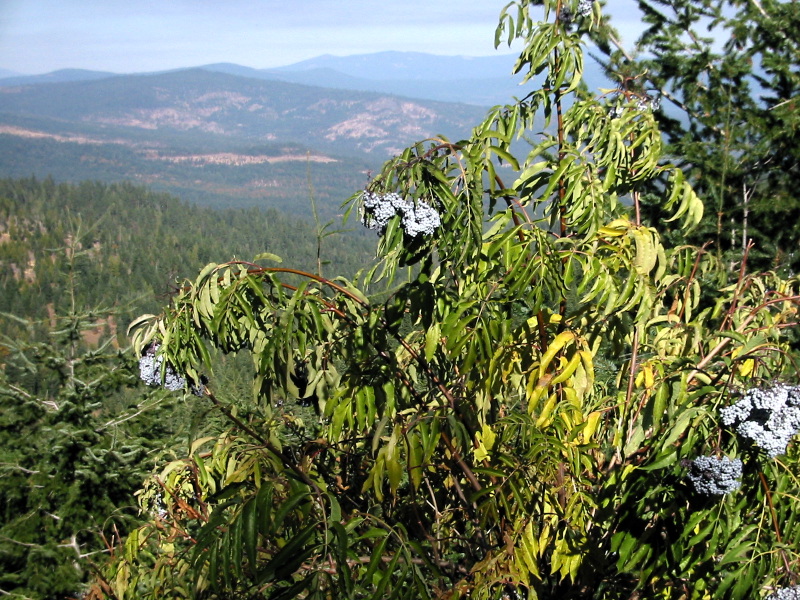
Blue elderberry (Sambucus caerulea)
At a glance
- Lifecycle
- Perennial (hardy)
- Exposure
- Full sun
- Frost limit
- −28.9 °C
Cultivation
Tolerates most soils, including chalk. A fast-growing but short-lived tree in the wild. A shrub at Kew in September 1993 was carrying a good crop of tasty fruits[K]. Plants in this genus are notably resistant to honey fungus.
Propagation
Seed - best sown as soon as it is ripe in the autumn in a cold frame, when it should germinate in early spring. Stored seed can be sown in the spring in a cold frame but will probably germinate better if it is given 2 months warm followed by 2 months cold stratification first. Prick out the seedlings into individual pots when they are large enough to handle. If good growth is made, the young plants can be placed in their permanent positions during the early summer. Otherwise, either put them in a sheltered nursery bed, or keep them in their pots in a sheltered position and plant them out in spring of the following year. Cuttings of half-ripe wood, 7 - 10cm with a heel, July/August in a frame. Cuttings of mature wood of the current season's growth 15 - 20cm with a heel, late autumn in a frame or a sheltered outdoor bed.
Edible uses
Fruit - raw, cooked or used in preserves. Some caution is advised, see the notes above on toxicity. Flowers - raw or cooked in fritters etc. Very pleasant and refreshing raw[K]. A pleasant tea is made from the dried flowers.
Medicinal uses
Haemostatic. An infusion or extract made from the flowers, bark and root has been used to cure fevers and gripe, it is also laxative. A decoction of the plant has been used as an antiseptic wash to treat itches. The bark is analgesic and astringent. The inner bark is strongly emetic. The leaves are analgesic, antiseptic, diaphoretic, febrifuge and purgative. A decoction of the root has been used in the treatment of bladder problems and dyspepsia. A decoction of the flowers has been used in the treatment of stomach troubles and lung complaints. A wine made from the fruit has been used as a tonic.
Material uses
A decoction of the leaves, when watered on plants, repels caterpillars. The hollow stems can be used as flutes and pipes. The pith of the stems has been used as a tinder for lighting fires. Wood - light, soft, weak, coarse grained. Of no commercial value, though it is used locally for flutes, skewers, pegs, straws etc.
Habitat
Gravelly, rather dry soils on stream banks, margins of fields, woodlands etc.
Native range
Western N. America - British Columbia to California, east to Montana, Texas and Mexico.