Smilax nipponica
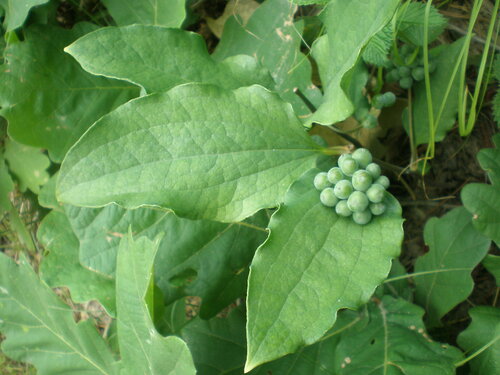
At a glance
- Lifecycle
- Perennial (hardy)
- Exposure
- Full sun
Cultivation
We have very little information on this species and do not know if it will be hardy in Britain, though judging by its native range it should succeed outdoors in many parts of the country. It is quite likely that this is the species referred to as S. herbacea nipponica in as applying to S. herbacea nipponica. The following notes are based on the general needs of the genus. Succeeds in most soils in sun or semi-shade. Dioecious. Male and female plants must be grown if seed is required.
Propagation
Seed - sow March in a warm greenhouse. This note probably refers to the tropical members of the genus, seeds of plants from cooler areas seem to require a period of cold stratification, some species taking 2 or more years to germinate[K]. We sow the seed of temperate species in a cold frame as soon as we receive it, and would sow the seed as soon as it is ripe if we could obtain it then[K]. When the seedlings eventually germinate, prick them out into individual pots when they are large enough to handle and grow them on in the greenhouse for at least their first year, though we normally grow them on in pots for 2 years. Plant them out into their permanent positions in early summer. Division in early spring as new growth begins. Larger divisions can be planted out direct into their permanent positions. We have found it best to pot up the smaller divisions and grow them on in a lightly shaded position in a cold frame, planting them out once they are well established in the summer. Cuttings of half-ripe shoots, July in a frame.
Edible uses
Leaves and young shoots - raw or cooked and used like asparagus. Fruit - raw or cooked and used in jellies etc. Root - cooked. It can be dried, ground into a powder and then used with cereals for making bread etc.
Medicinal uses
The roots are antispasmodic and carminative. They stimulate the circulation.
Habitat
Meadows and thickets in mountains, C. and S. Japan.
Native range
E. Asia - Japan, Korea.