Snowberry (Symphoricarpos albus laevigatus)
Other names common snowberry, smooth-leaved snowberry
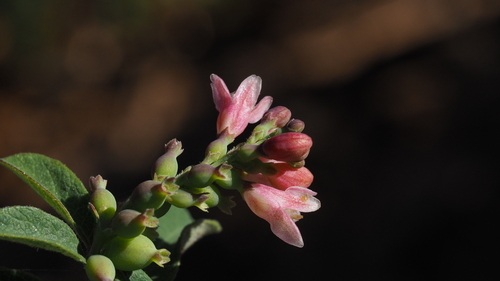
At a glance
- Lifecycle
- Perennial (hardy)
- Exposure
- Full sun
- Frost limit
- −40 °C
Cultivation
Tolerates most soils and conditions, including poor soils and amongst the roots and under the drip of trees. A very hardy plant, tolerating temperatures down to about -40°c. A very ornamental but invasive plant, spreading by means of suckers. There are some named varieties, developed for their ornamental value. 'Constance Spry' bears a copious crop of large round berries. Plants in this genus are notably resistant to honey fungus.
Propagation
Seed - best sown as soon as it is ripe in a cold frame. Stored seed requires 3 months warm then 5 months cold stratification. When they are large enough to handle, prick the seedlings out into individual pots and grow them on in the greenhouse for their first winter. Plant them out into their permanent positions in late spring or early summer, after the last expected frosts. Cuttings of half-ripe wood, July/August in a frame. Cuttings of mature wood, 15 - 25cm long preferably with a heel, in a sheltered bed outdoors in winter. High percentage. Division of suckers in winter. They can be planted straight Tu into their permanent positions.
Edible uses
Fruit - raw or cooked. See the notes at top of page regarding possible toxicity.
Medicinal uses
Snowberry was commonly employed medicinally by several native North American Indian tribes who valued it especially for the saponins it contains. These saponins can be toxic, but when applied externally they have a gentle cleansing and healing effect upon the skin, killing body parasites and helping in the healing of wounds. The native Americans used it to treat a variety of complaints but especially as an external wash on the skin. The plant is little, if at all, used in modern herbalism. Any internal use of this plant should be carried out with care, and preferably under the supervision of a qualified practitioner. See the notes above on toxicity. The whole plant is disinfectant, diuretic, febrifuge and laxative. An infusion of the stems has been drunk to treat stomach problems and menstrual disorders. A decoction of the leaves has been used in the treatment of colds. A weak solution of the stems and leaves has been used as a wash for children whilst a stronger solution is applied to sores. The fruit has been eaten, or used as an infusion, in the treatment of diarrhoea. A poultice of the crushed leaves, fruit and bark has been used in the treatment of burns, sores, cuts, chapped and injured skin. An infusion of the roots has been used in the treatment of fevers (including childhood fevers), stomach aches and colds. An infusion of the whole plant has been drunk and also applied externally in the treatment of skin rashes. A decoction of the roots and stems has been used in the treatment of the inability to urinate, venereal disease, tuberculosis and the fevers associated with teething sickness.
Material uses
Plants have extensive root systems and are used to stabilize soils on banks and slopes. The branches can be tied together and used as a broom. The berries contain saponins and have been used as a hair wash. A mild decoction of the wood has been used as a cleansing wash for babies. The crushed berries have been rubbed into the armpits as an antiperspirant. Very tolerant of trimming, it can be grown as a medium to tall hedge. Its main drawback as a hedge is its propensity to sucker[K].
Habitat
Banks and flats in canyons and near streams below 1200 metres in California.
Native range
Western N. America. Naturalized in Britain.