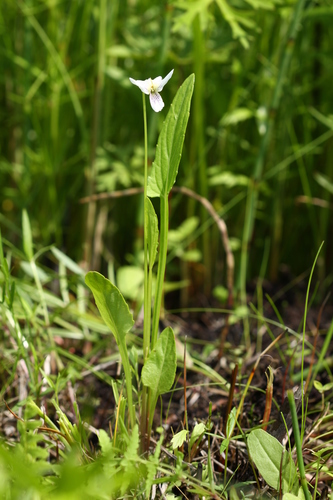
Stemless violet (Viola patrinii)
Other names China violet
At a glance
- Lifecycle
- Perennial (hardy)
- Exposure
- Full sun
Cultivation
Prefers a cool moist well-drained humus-rich soil in partial or dappled shade and protection from scorching winds. Tolerates sandstone and limestone soils but becomes chlorotic if the pH is too high. Prefers a pH between 6 and 6.5. All members of this genus have more or less edible leaves and flower buds, though those species with yellow flowers can cause diarrhoea if eaten in large quantities.
Propagation
Seed - best sown in the autumn in a cold frame. Sow stored seed in early spring in a cold frame. Prick out the seedlings into individual pots when they are large enough to handle and plant them out in the summer. Division in the autumn or just after flowering. Larger divisions can be planted out direct into their permanent positions, though we have found that it is best to pot up smaller divisions and grow them on in light shade in a greenhouse or cold frame until they are growing away well. Plant them out in the summer or the following spring.
Edible uses
Young leaves and flower buds - raw or cooked. A tea can be made from the leaves.
Medicinal uses
This species has a long history of folk use in the treatment of cancer and other diseases. The fresh roots are mashed and used as a poultice for abscesses. The plant is suppurative for abscesses, cancer, inflammations and ulcers.
Habitat
Usually found under forest shade, 1900 - 2700 metres in the Himalayas.
Native range
E. Asia - Japan, Siberia.