Ribes sativum (Ribes rubrum hortense)
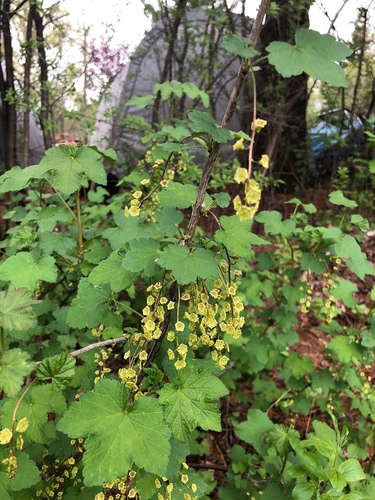
At a glance
- Lifecycle
- Perennial (hardy)
- Exposure
- Full sun
- Time to harvest
- 120–150 days
- Frost limit
- −28.9 °C
Cultivation
Easily grown in a moisture retentive but well-drained loamy soil of at least moderate quality. Hardy to about -20°c. Red currants are often cultivated in temperate zones for their edible fruit, there are some named varieties, including forms with white fruits. This is an aggregate species comprising R. spicatum and R. rubrum. There is some confusion in nomenclature with some botanists only recognising 2 species, R. silvestre. (syn R. sativum) and R. spicatum (syn R. rubrum). Plants can harbour a stage of white pine blister rust, so should not be grown in the vicinity of pine trees.
Propagation
Seed - best sown as soon as it is ripe in the autumn in a cold frame. Stored seed requires 3 months cold stratification at between 0 and 5°c and should be sown as early in the year as possible. Under normal storage conditions the seed can remain viable for 17 years or more. Prick out the seedlings into individual pots when they are large enough to handle and grow them on in a cold frame for their first winter, planting them out in late spring of the following year. Cuttings of half-ripe wood, 10 - 15cm with a heel, July/August in a frame. Cuttings of mature wood of the current year's growth, preferably with a heel of the previous year's growth, November to February in a cold frame or sheltered bed outdoors.
Edible uses
Fruit - raw or cooked. A pleasant acid flavour, it can be eaten out of hand but is more often cooked in pies, jams etc[K]. There are rather a lot of seeds in each fruit[K].
Medicinal uses
The fruit is antiscorbutic, aperient, depurative, digestive, diuretic, laxative, refrigerant and sialagogue. The leaves contain the toxin hydrogen cyanide.
Material uses
A yellow dye is obtained from the leaves. A black dye is obtained from the fruit. The fruit is used cosmetically in face-masks for firming up tired and lifeless skin.
Habitat
Damp soils in hedges and woods, avoiding acid soils.
Native range
Western Europe, including Britain.
Scientific synonyms Ribes sativum