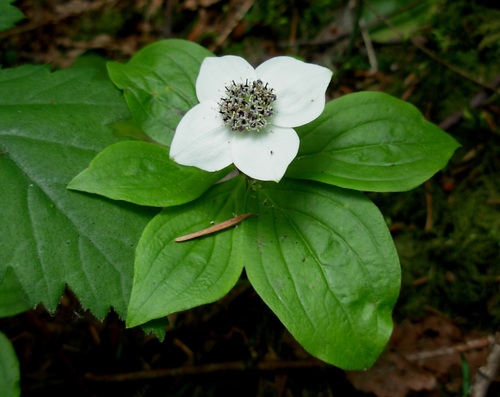
Bunchberry (Cornus x unalaschkensis)
At a glance
- Lifecycle
- Perennial (hardy)
- Exposure
- Full sun
- Frost limit
- −45.6 °C
Cultivation
Requires a moist peaty acid sandy soil. This is a naturally occurring hybrid, C. canadensis x C. suecica, and is intermediate in characteristics between the parents.
Propagation
Seed - best sown as soon as it is ripe in a cold frame or in an outdoors seedbed if there is sufficient seed. Prick out the seedlings of cold-frame sown seeds into individual pots as soon as they are large enough to handle and grow the plants on for their first winter in a greenhouse, planting out in the spring after the last expected frosts. This species is a hybrid and so might not breed true from seed. Division in spring. This plant can be a bit temperamental when it is being divided. We have found it best to tease out small divisions from the sides of the clump, to avoid the need to disturb the main clump by digging it up. Try to ensure that each division has already produced some roots. Pot them up in light shade in a greenhouse and make sure that they are not allowed to become dry. Once they are rooting and growing away well, which might take 12 months, they can be planted out into their permanent positions.
Edible uses
Fruit - raw or cooked. A small berry about 6mm in diameter[K]. The fruit is rich in pectin.
Material uses
The following use is for the closely related C. suecica, but it almost certainly also applies to this plant[K]:- The fruit is rich in pectin. A good ground-cover plant, succeeding under trees and shrubs.
Habitat
Not known
Native range
Northern N. America - Alaska, Newfoundland.