Pink Mountain Berry (Cyathodes parviflora)
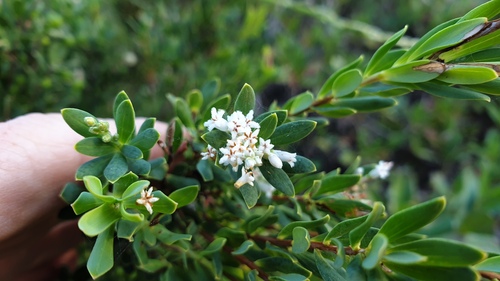
At a glance
- Lifecycle
- Perennial (hardy)
- Exposure
- Partial shade
Cultivation
Requires a moist well-drained lime-free humus rich soil in a sheltered site in partial or dappled shade. Plants are very susceptible to drought. A good rock garden plant. Slow growing. There is some doubt in my mind over the correct spelling of this species. The RHS dictionary has an entry on C. parviflora from New Zealand which also occupies rocky habitats, it is possible that C parvifolia is just a mis-spelling of C. parviflora or vice versa. This species is not very hardy in Britain, it might succeed outdoors in the mildest areas of the country otherwise it is best grown in a cold greenhouse. Plants are hardy to at least -7°c in Australian gardens though this cannot be translated directly to British gardens because of our cooler summers and longer, colder and wetter winters. Plants grow best in areas with moderate winters and cool moist summers. Plants have very fine root systems and great care must be taken when transplanting them.
Propagation
Seed - surface sow in ericaceous soil, February/March in a cold frame. Do not exclude light. Germination can take place within 1 - 2 months at 18°c but often takes 3 - 5 years. Scarification will reduce the germination time and 2 or 3 periods of 4 - 6 weeks cold stratification alternated with 4 weeks warm stratification can also help. Perhaps sowing the seed as soon as it is ripe would also be beneficial. The seedlings can be very slow to form roots and need to be potted up with great care. Grow them on for at least two years in the greenhouse before planting them out in late spring or early summer. Cuttings of half-ripe wood, July/August in a frame. Neither easy nor reliable. Air layering.
Edible uses
Fruit - raw or cooked. Pleasantly sweet and juicy but it has a large seed.
Material uses
Wood - tough and hard.
Habitat
Drier rocky slopes to 1200 metres.
Native range
Australia - New South Wales, Tasmania. New Zealand.