Mexican Elder (Sambucus mexicana)
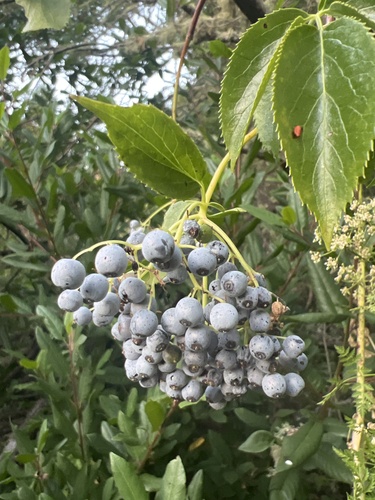
At a glance
- Lifecycle
- Perennial (hardy)
- Exposure
- Full sun
Cultivation
We have very little information on this species and do not know if it will be hardy in Britain, though judging by its native range it should succeed outdoors in many parts of this country. It is closely related to S. caerulea. The following notes are based on the general needs of the genus. Tolerates most soils, including chalk. Plants in this genus are notably resistant to honey fungus.
Propagation
Seed - best sown as soon as it is ripe in the autumn in a cold frame, when it should germinate in early spring. Stored seed can be sown in the spring in a cold frame but will probably germinate better if it is given 2 months warm followed by 2 months cold stratification first. Prick out the seedlings into individual pots when they are large enough to handle. If good growth is made, the young plants can be placed in their permanent positions during the early summer. Otherwise, either put them in a sheltered nursery bed, or keep them in their pots in a sheltered position and plant them out in spring of the following year. Cuttings of half-ripe wood, 7 - 10cm with a heel, July/August in a frame. Cuttings of mature wood of the current season's growth 15 - 20cm with a heel, late autumn in a frame or a sheltered outdoor bed.
Edible uses
Flowers - raw or cooked. Fruit - raw or cooked. Some caution is advised, see the notes above on toxicity.
Medicinal uses
An infusion of the blossoms has been used in the treatment of upset stomachs, fevers, sore throats, colds and flu. A decoction of the roots has been used in the treatment of constipation.
Material uses
A purple to black dye is obtained from the fruits. An orange to yellow dye is obtained from the stems. Wood - soft and coarse-grained.
Habitat
Open flats and cismontane valleys and canyons below 1850 metres in California.
Native range
South-western N. America - California to New Mexico, south to Mexico.